 By cryptoadmin
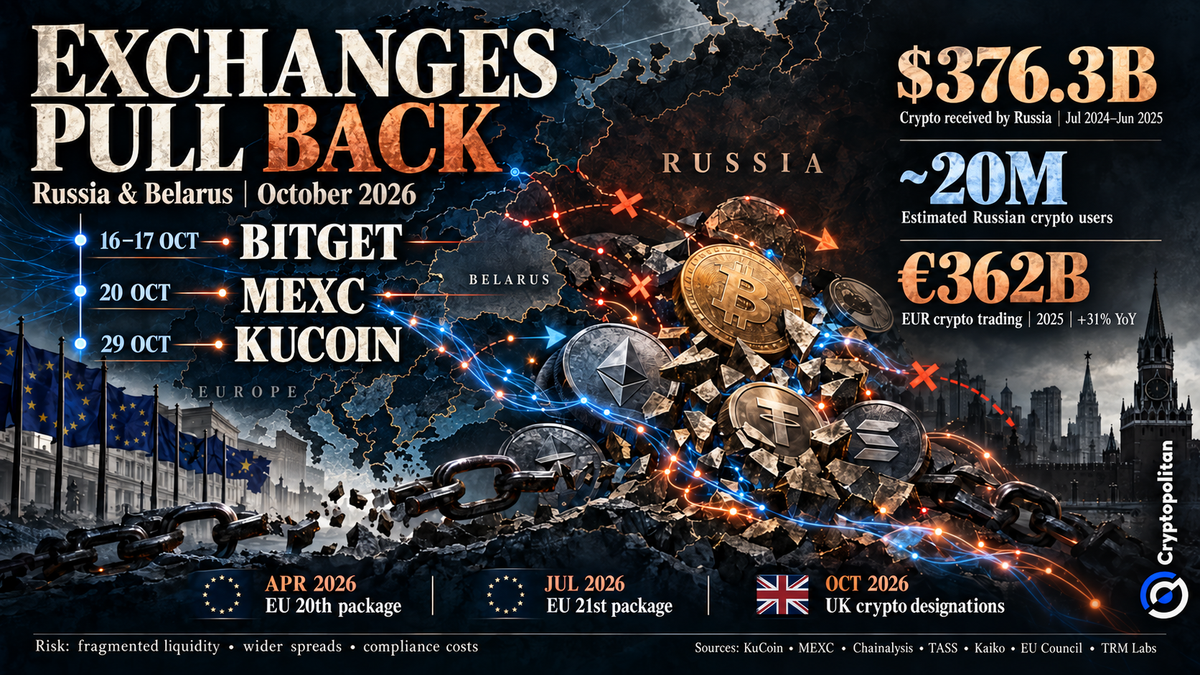
KuCoin has ceased its operations involving customers in Russia and Belarus on October 29 on the ground of following regulations; however, the sanctions were not specified. Earlier in October, Bitget and MEXC introduced the same limitations. Hence, after three exchanges have halted their work in just one month, people are interested in where the affected traders will relocate their funds.
At this time, the answer is still unclear. There has been no indication on the part of the exchanges in terms of how many customers are affected or how much trading volume is expected to be lost. Although withdrawals confirm that international exchanges are under increasing pressure, it is too early to conclude whether this means that they are pulling out of the Russian and Belarusian markets altogether.
A compliance notice with no named sanction
The announcement from KuCoin was clear and concise: all products and services will be terminated immediately. Affected customers will receive instructions on when to liquidate their positions and withdraw their funds. However, customers who do not get any such instruction will not need to act.
By citing only “applicable legal and regulatory requirements,” KuCoin has left the reason ambiguous. It has not specified any measures from the EU or the UK that necessitated this action.
MEXC moved first, Bitget tightened too
MEXC was among the exchanges to move before KuCoin. On October 20, it announced its withdrawal from Russia and Belarus, saying affected customers would receive instructions on closing positions and withdrawing their assets. Bitget had moved even earlier, tightening its terms on October 16 to restrict users in Russia, Belarus, and Kazakhstan. Some affected customers were given until October 21 to withdraw their funds.
But Bitget specified that the restrictions concern only a number of accounts. MEXC and Bitget did not provide any information about the number of users affected or the potential volume of trading that could be shifted to other platforms, hence making it impossible to assess the overall effect on the market.
Why Brussels and London keep pressure on
Sanctions offer insight into the factors at play but not necessarily the choice made by KuCoin itself. The EU’s 20th sanctions package issued in April banned the use of cryptocurrencies with companies registered in Russia and Belarus. The July 23 sanctions package (21st package) went further by extending the restrictions to 14 other crypto companies abroad, paving the way for other third-party sanctions. HTX was included in the sanctions list as reported by Cryptopolitan.
The UK has also stepped up its pressure. On October 8, it sanctioned Xeltox, the company linked to Cryptomus, along with Kyrgyzstan-based TokenSpot. According to TRM Labs, TokenSpot sent more than $950 million to Grinex, Garantex and the A7 network. The distinction matters: these sanctions target specific service providers and suspected channels for evading restrictions, rather than Russian cryptocurrency holders in general.
Big numbers on both sides of the border
These withdrawals matter because Russia remains a major cryptocurrency market. According to Chainalysis, the country received $376.3 billion in crypto between July 2024 and June 2025, compared with Britain’s $273.2 billion. However, those figures measure on-chain transactions, not trading volumes on individual exchanges.
Deputy Finance Minister Ivan Chebeskov told TASS that roughly 20 million Russians use cryptocurrency, with holdings worth 3.7 trillion rubles in digital assets and related products. Neither estimate reveals how many people trade on KuCoin.
Meanwhile, euro-denominated crypto trading continues to grow. Kaiko reported €362 billion in trading volume in 2025, up 31% from the previous year. Its analyst, Laurens Fraussen, linked that growth partly to Europe’s regulatory framework:
“MiCA’s implementation has driven regulatory confidence, which in turn deepened liquidity and tightened spreads.”
Where the trading could move next
The bigger question is where affected traders will go. Russia is developing its own licensed cryptocurrency market, but Chebeskov outlined regulatory deadlines extending into July 2027. That system cannot yet be counted on to absorb the displaced activity.
Some traders could move to other offshore exchanges, domestic intermediaries or decentralized platforms. If trading becomes scattered across more venues, liquidity could thin, spreads could widen and compliance costs could rise.
For now, however, there is no clear evidence showing where that trading activity has moved or how much liquidity is at stake.