 By cryptoadmin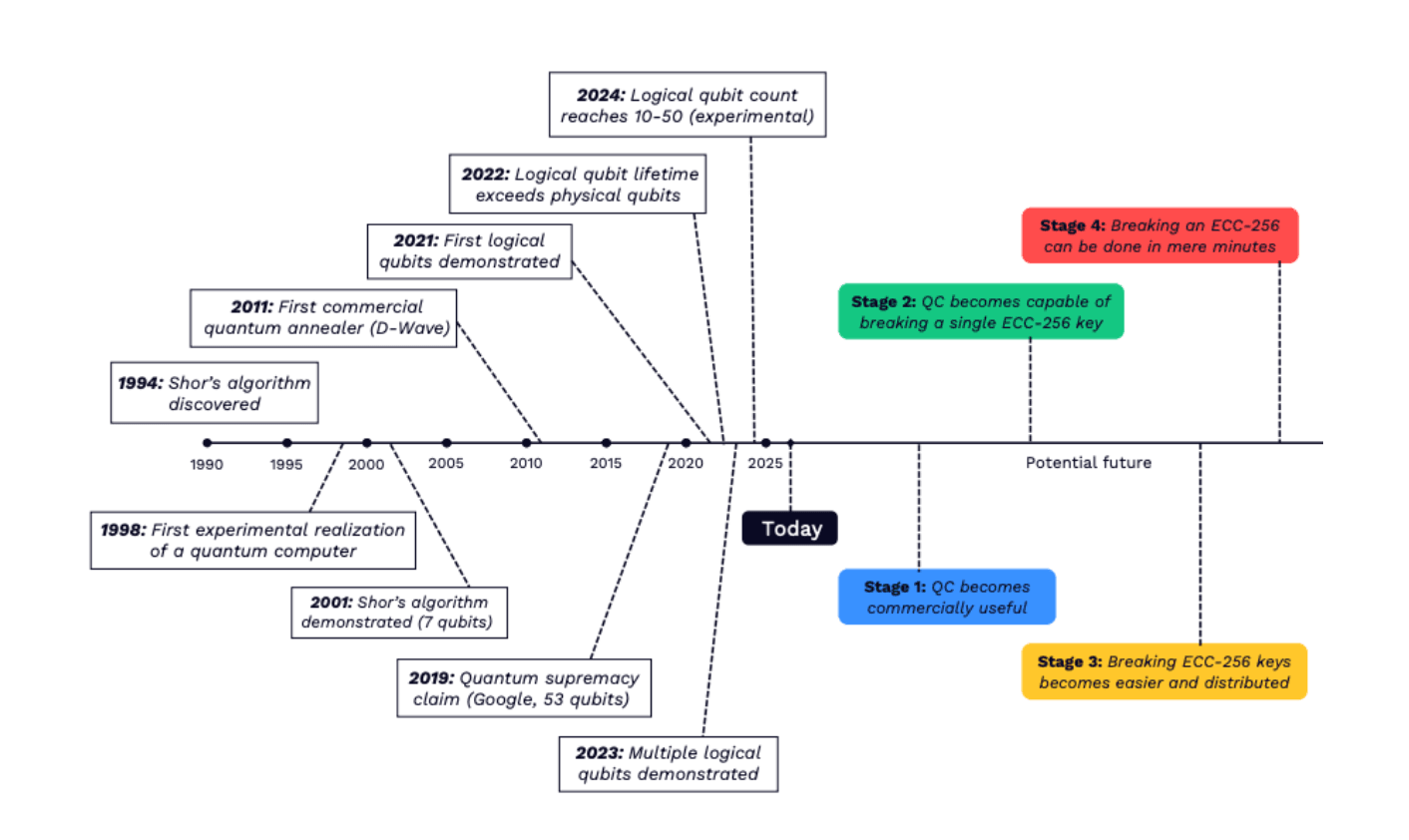
As quantum computing edges closer to practical reality, the crypto industry is beginning to confront a question it has long deferred: what happens if the cryptography underpinning trillions of dollars in digital assets no longer holds?
The answers, so far, are anything but uniform.
Across many of the most well-known ecosystems like Bitcoin, Ethereum, and Solana, responses are diverging along familiar lines: what to do on social consensus and technical iteration, and community members are split between caution and acceleration.
Quantum computing is a fundamentally different approach to computation that uses the principles of quantum mechanics rather than classical physics. Instead of traditional bits that are either 0 or 1, quantum computers use “qubits,” which can exist in multiple states at once, a property known as superposition, allowing them to process many possibilities simultaneously.
Combined with another feature called entanglement, this enables quantum machines to solve certain complex problems far more efficiently than classical computers, particularly tasks like factoring large numbers that underpin modern encryption.
How threatening is quantum computing? Consider this: Quantum computers can solve extremely complex problems within seconds, whereas 'Supercomputers,' the most powerful computing machines available today, would take thousands of years for the same problems, according to IBM.
And that's why the threats to cryptographic networks stemming from quantum computing are concerning. And even Google, developer of Willow, a quantum supercomputer, is setting a 2029 deadline to migrate its authentication services to post-quantum cryptography, citing progress in the technology.
Fierce Bitcoin debate
Nowhere is the tension more visible than in Bitcoin.
While the risks posed by quantum computing have been understood since the network’s earliest days, the debate began meaningfully a few years back, when developers started more seriously discussing post-quantum signature schemes and the long-term implications of exposed public keys.
The threat became very real recently, when some Wall Street analysts, such as Jefferies, said investors should drop bitcoin from their portfolios altogether because of the looming risk to the network. While that has struck a nerve with some investors, others, including Cathie Wood's Ark Invest, came to defend Bitcoin, saying quantum computing is a long-term risk but a risk nonetheless.
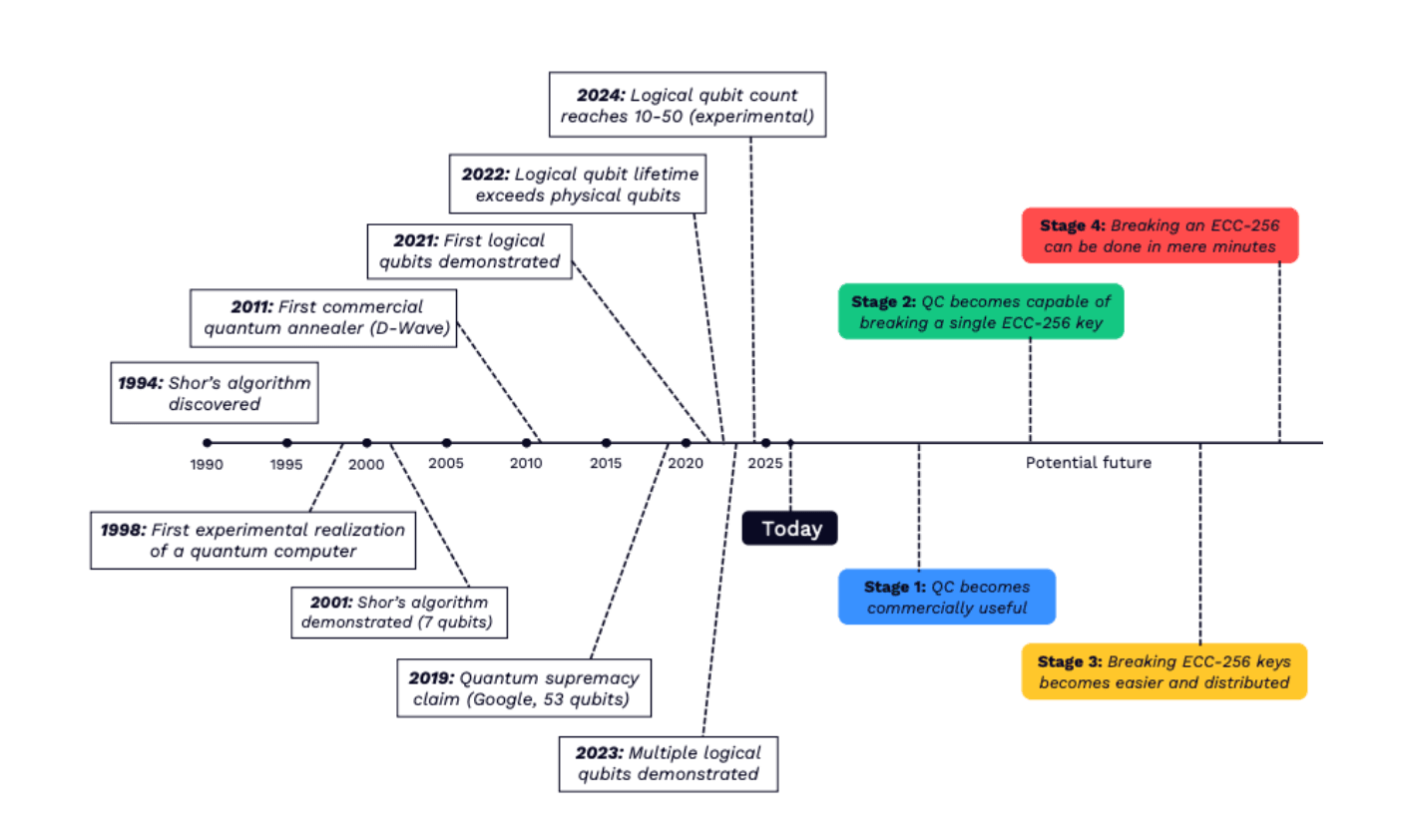
For years, these discussions remained largely academic, but as Taproot activated in 2021 and quantum research continued to advance, attention shifted toward practical questions — how to migrate funds, how to handle vulnerable coins, and whether upgrades could be introduced without breaking Bitcoin’s core guarantees. More recently, that abstract concern has started to crystallize into concrete proposals.
Developers are now focusing on a basic issue: some older bitcoin could be easier to break if quantum computers improve. One proposal, called BIP360, is about helping users move those coins into safer addresses over time, rather than forcing a sudden network-wide change. At the same time, more experimental ideas are being discussed. One, known as “Hourglass,” would gradually limit the use of vulnerable coins unless they’re moved, giving owners time to act while reducing the risk of theft. While some estimates say millions of bitcoin — including about 1 million linked to Satoshi — could be exposed, not everyone sees this as a major threat. Some argue the market could absorb it, and that the bigger risk is making drastic changes that go against Bitcoin’s core principles.
That tension underscores a deeper challenge: any solution must navigate Bitcoin’s core ethos of immutability and minimal intervention. As a result, Bitcoin’s quantum strategy is emerging not as a single roadmap, but as a spectrum of proposals whose fate will depend less on technical feasibility than on whether the community can reach consensus without compromising the principles that define the network.
Read more: Bitcoin’s quantum threat is real, but far from an existential crisis, Galaxy says
Ethereum and Coinbase
If Bitcoin is still debating 'whether' to act, Ethereum and its surrounding ecosystem have largely moved on to 'how.'
Throughout 2025, the Ethereum Foundation quietly ramped up efforts by creating a dedicated quantum research team and elevating post-quantum security from a theoretical concern to a strategic priority. The shift reflects a growing sense among core developers that timelines may be compressing, and that preparation cannot wait for definitive breakthroughs in quantum hardware.
The Ethereum roadmap is not about a single upgrade, but a phased transition. Research has focused on integrating post-quantum signature schemes into future iterations of the protocol, alongside broader architectural changes like LeanVM, which aim to make the system more adaptable to new cryptographic primitives. Rather than forcing an abrupt migration, the goal is to build optionality: allowing developers and users to adopt quantum-resistant tools incrementally, without breaking compatibility with existing infrastructure.
That same philosophy is visible with some of the biggest companies in crypto. Coinbase, one of the largest U.S.-based crypto exchanges, recently established an independent advisory board composed of cryptographers, academics and quantum computing experts. The group is tasked with assessing risks, guiding implementation strategies and ensuring that defenses evolve alongside the threat landscape. The move signals that quantum preparedness is no longer confined to protocol developers — it is becoming a business and operational concern as well.
Ethereum layer-2 networks are also beginning to map their own paths. Optimism, a major Ethereum scaling solution, has outlined early thinking around post-quantum upgrades. While still at a conceptual stage, the effort underscores a broader trend: rather than waiting for a single, ecosystem-wide solution, different layers of the stack are beginning to experiment in parallel.
Taken together, Ethereum’s approach has recognized that quantum risk is real, but that the transition must be carefully managed to avoid introducing new vulnerabilities.
Solana's quiet shift
Solana, by contrast, has taken a quieter and more experimental route.
In December 2025, developers in its orbit began introducing early designs for quantum-resistant tooling, including a concept known as the “Winternitz Vault.” The idea is to give users the option to store assets in smart contract-based vaults secured by hash-based, one-time signatures—an approach widely considered more resistant to quantum attacks.
Unlike a protocol-level overhaul, these vaults function as an additional security layer. Users who are concerned about long-term quantum risk can opt in, while the broader network continues to operate unchanged. For now, Project Eleven will lead the charge to advance post-quantum security for Solana.
The initial reaction from the Solana community has been broadly positive, with developers and users welcoming the experimentation. Still, quantum computing has not emerged as a sustained flashpoint in ecosystem discourse, and discussion remains relatively subdued compared to the more urgent debates playing out elsewhere.
This divergence in approaches highlights a deeper truth about the crypto industry: there is no consensus yet on how urgent the quantum threat really is. Some argue that practical attacks may still be years away, or that they are overblown. Others warn that the transition to quantum-resistant systems could take just as long, meaning preparation must begin well in advance.
What is clear is that the issue is no longer hypothetical. The creation of dedicated research teams, advisory boards and experimental tools marks a shift from abstract concern to active planning. Even in Bitcoin, where change is hardest, the mere fact that freezing coins is being discussed signals how far the conversation has moved.
For now, the industry’s response resembles an early stress test rather than a coordinated defense.
Read more: Quantum threat gets real: Ethereum Foundation prioritizes security with leanVM and PQ signatures