 By cryptoadmin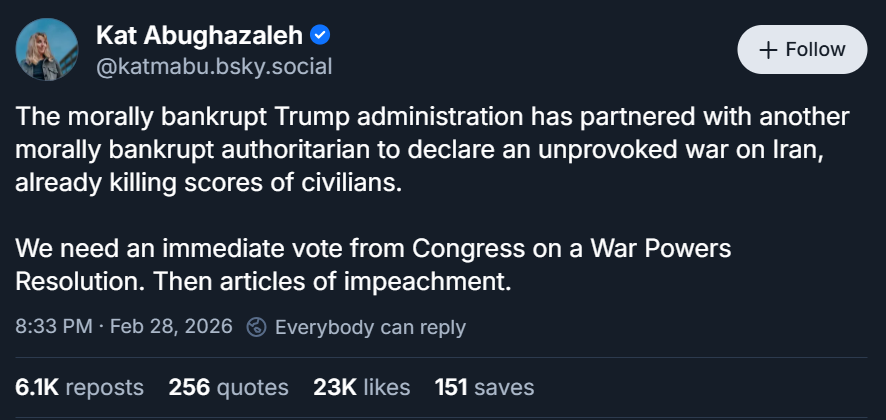
As the United States continues to be involved in the Middle East crisis and voters are ready to cast ballots in less than eight months, pressure to impeach President Donald Trump is intensifying.
However, the figures indicate that the road ahead is far from simple.
Democrats and political rivals have turned up the heat in recent weeks. Still, the data make clear that removing Trump from office is a tall order.
Betting platforms are beginning to reflect the tension. On Polymarket, 14% of bettors think Trump will be impeached before the end of 2026, and 17% believe he will leave office before 2027. Rival platform Kalshi puts the odds of impeachment by June 1, 2026, at just 2%, rising to 13% by January 1, 2027, and reaching 71% by January 1, 2028.
The midterm elections, scheduled for Tuesday, November 3, 2026, will put all 435 House seats and 35 of the 100 Senate seats up for a vote.
Democrats are positioned to flip the house
In a generic ballot survey conducted by RealClearPolling, 47.8% of respondents said they would vote Democratic and 43.1% said they would support Republicans. Democrats have an 85% chance of winning the House, according to Polymarket.
Republicans have a slim chance of maintaining the Senate’s 53% majority. A full Democratic sweep is valued at 48%, a Republican sweep at just 17%, and the most likely divided outcome, a Republican Senate and Democratic House, at 35%.
See also Inside China's Xi and diplomats plan to turn the world against the US as Trump cuts trade deals
Democrats would be able to impede Trump’s policy program, make negotiations over the debt ceiling more difficult, and forward the impeachment process if they were to win the House.
The war in the Middle East has become the loudest trigger for those calls. Several Democratic congressional candidates, including Christian Menefee in Texas and Illinois candidates Kat Abughazaleh, state Senator Laura Fine, and Mayor Daniel K. Biss.
Abughazaleh has not held back. In one post, she wrote that the Trump administration had “partnered with another morally bankrupt authoritarian to declare an unprovoked war on Iran, already killing scores of civilians.”
She called on Congress to vote on a War Powers Resolution and then move to articles of impeachment. In another post, she said that the obsession of the U.S. and Israel with regime change was “abhorrent.”
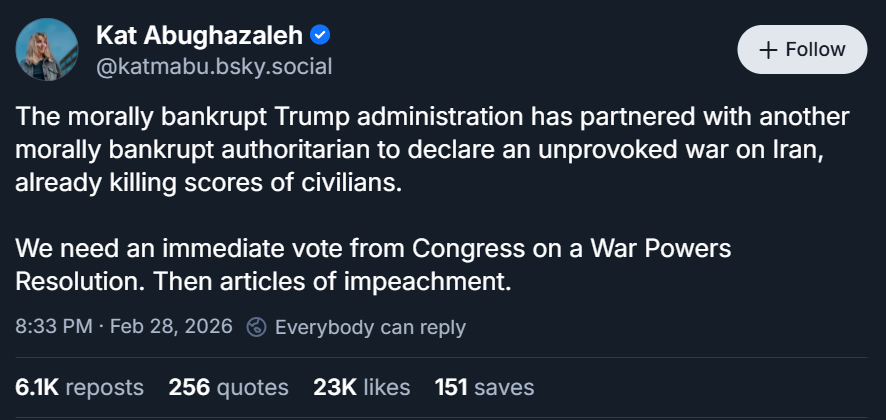 Kat Abughazaleh blasts Trump’s “morally bankrupt” administration
Source: @katmabu.bsky.social
The question of who holds the constitutional power to take the country to war sits at the heart of the debate. Congress, not the president, has the power to declare war under Article I, Section 8 of the Constitution.
Before starting hostilities, Trump did not confer with Congress. Rather, he worked directly with Israel while U.S. politicians mostly stood by as the violence intensified and American service members were slain.
See also U.S. Treasury to ease corporate crypto tax rule
War rattles oil markets and growth forecasts
Financial markets have also been severely impacted by the turmoil. Oil prices have increased due to threats to the Strait of Hormuz, and experts are already lowering their growth projections.
Real GDP growth for the fourth quarter is now forecast at 2.2%, down from 2.6% just a month ago. About half of that drop is being blamed on rising energy costs.
Furthermore, inflation has been steadily rising once more. January figures are expected to be significantly higher, sustaining price increases well over the Federal Reserve’s 2% objective.
The government has imposed a 15% charge on all countries using Section 122 of the US tariff law.
Gold has increased by more than 8% as investors look for safer havens, indicating general anxiety about the future. In January 2027, the House will have a significant impact on whether Congress ultimately exercises its right to declare war or keeps that power in the hands of the president.
Growing chances of impeachment indicate more political unrest in 2026, which could significantly raise economic uncertainty. A Democratic takeover of the House is likely to result in impasse on fiscal and debt-ceiling matters due to impeachment.
This would increase the likelihood of a recession, erode investor confidence, and prolong market volatility past the midterm elections.