 By cryptoadmin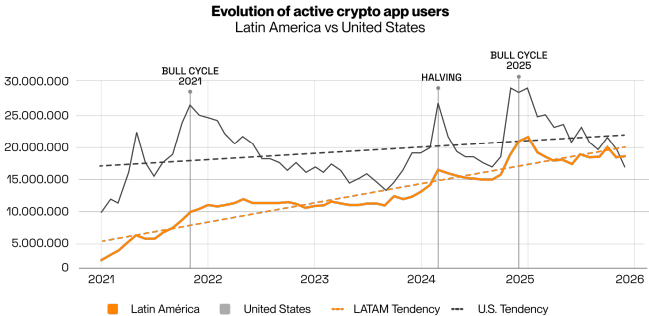
Latin America’s crypto market is expanding far faster than that of the United States as users increasingly rely on cryptocurrencies for payments and cross-border transfers rather than speculation. a new report claims.
The region, according to a report from Argentinian crypto firm Lemon, received more than $730 billion in cryptocurrency transaction volume in 2025, a 60% increase from the previous year, representing roughly 10% of global crypto activity.
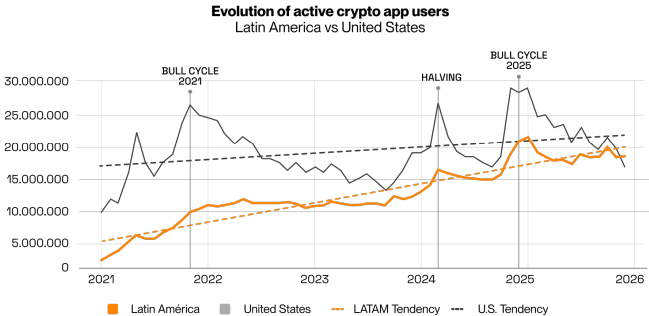
Growth was not only measured in transaction volume. Monthly active crypto app users in Latin America rose about 18% year over year, roughly three times faster than growth in the United States, the report said.
Brazil dominates the region by transaction size.
The country received $318.8 billion in crypto value with growth approaching 250% year over year, driven largely by institutional trading and expanding regulatory clarity for financial institutions.
Argentina shows a different pattern. Despite inflation falling to about 32% in 2025, crypto adoption continued to rise. Average monthly users were four times higher than during the 2021 bull market, according to the report.
One driver is cross-border payments. Argentine fintech companies linked crypto rails to Brazil’s PIX instant payment system, allowing users to pay Brazilian merchants using pesos while stablecoins such as USDT settle the transaction behind the scenes.
The integration led to 5.4 million crypto app downloads in Argentina during 2025, with January downloads hitting a record level.
Peru, which back in January saw Bybit Pay integrate with digital wallets Yape and Plin, emerged as one of the fastest-growing markets. Crypto app users doubled as interoperability rules allowed banks and digital wallets to connect. Transfers between banks and wallets surpassed 540 million transactions, up 120% year over year.
Stablecoins are playing a central role in the shift toward practical use cases. Across the region, users rely on digital dollars to send money abroad, receive funds from platforms like PayPal and bypass traditional banking networks, the report points out.