 By cryptoadmin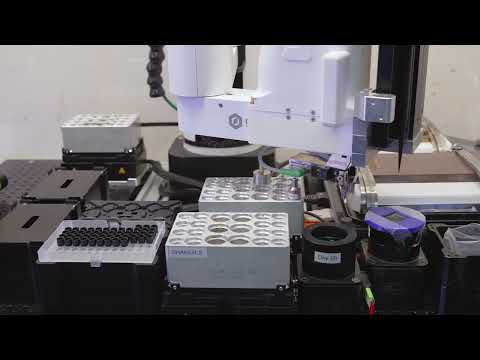
September 18, 2025
The GIST Autobot platform uses machine learning to rapidly find best ways to make advanced materials 
Lisa Lock
scientific editor

Robert Egan
associate editor
Editors' notes
This article has been reviewed according to Science X's editorial process and policies. Editors have highlighted the following attributes while ensuring the content's credibility:
fact-checked
peer-reviewed publication
trusted source
proofread

A research team led by the Department of Energy's Lawrence Berkeley National Laboratory (Berkeley Lab) has built and successfully demonstrated an automated experimentation platform to optimize the fabrication of advanced materials. The platform, called AutoBot, uses machine learning algorithms to direct robotic devices to rapidly synthesize and characterize materials. The algorithms automatically refine the experiments based on analysis of the characterization results.
The researchers tested the platform on an emerging class of materials called metal halide perovskites that show promise for applications such as light-emitting diodes (LEDs), lasers, and photodetectors. It took AutoBot just a few weeks to explore numerous combinations of fabrication parameters to find the combinations that yield the highest quality materials.
Informed by machine learning algorithms with a super-fast learning rate, AutoBot needed to experimentally sample just 1% of the 5,000 combinations to find this "sweet spot." This process would have taken up to a year with the traditional trial-and-error approach, where researchers manually test one set of parameters at a time, guided by previous experience and intuition.
"AutoBot represents a paradigm shift for material exploration and optimization," said Carolin Sutter-Fella, a Berkeley Lab scientist and one of the study's corresponding authors. "By integrating synthesis, characterization, robotics, and machine learning capabilities in a single platform, AutoBot dramatically accelerates the process of screening synthesis recipes. Its rapid learning approach is a significant step toward establishing autonomous optimization laboratories and can be expanded to a wide range of materials and devices."
Scientists at the Molecular Foundry—a Department of Energy Office of Science User Facility located at Berkeley Lab—conceived the idea for AutoBot, expanded on a commercial robotics platform, and implemented solutions for data processing, analysis, and machine learning infrastructure.
The multidisciplinary team included researchers from the University of Washington, University of Nevada, University of California–Davis, University of California–Berkeley, and Friedrich-Alexander-Universität Erlangen–Nürnberg.
The scientists report their work in the journal Advanced Energy Materials.
An iterative learning loop
Because metal halide perovskites are extremely sensitive to humidity, stringent atmospheric controls are needed to make high-quality thin films. As a result, cost-effective, industrial-scale manufacturing is difficult to implement. The team used AutoBot to identify the synthesis conditions that can produce good quality thin-film materials in higher humidity environments, addressing a key barrier to large-scale production.
AutoBot repeated a series of tasks while automatically adjusting the tasks based on analysis of the results. This iterative learning loop proceeded as follows:
- AutoBot synthesized halide perovskite films from chemical precursor solutions, varying four synthesis parameters—the timing of treating the solutions with a crystallization agent; heating temperature; heating duration; and relative humidity in the film deposition chamber.
- The platform characterized samples with three techniques: measuring how much ultraviolet and visible light passes through the samples (UV-Vis spectroscopy); shining light on them and measuring the emitted light (photoluminescence spectroscopy); and using the emitted light to generate images of the samples to evaluate thin-film homogeneity (photoluminescence imaging).
- A data workflow extracted information from the characterization results, analyzing and combining the data into a single score representing the quality of the films.
- Based on these scores, machine learning algorithms modeled the relationship between the synthesis parameters and film quality and decided on the next experiments. These decisions were made with the objective of assessing the most informative parameter combinations to maximize information gain with each iteration. This enabled efficient, accurate predictions of thin-film material quality for all the parameter combinations.
Super-fast learning
AutoBot found that high-quality films can be synthesized at relative humidity levels between 5% and 25% by carefully tuning the other three synthesis parameters.
"This humidity range does not require stringent environmental controls," said Ansuman Halder, a Berkeley Lab postdoctoral researcher and co-first author of the research paper. "The finding lays important groundwork for the development of commercial manufacturing facilities."
Another insight was that humidity levels above 25% destabilized the material during the deposition process, resulting in poor film quality. The team explained and validated this finding by manually performing photoluminescence spectroscopy during film synthesis.
AutoBot's performance was impressive. By identifying the most informative experiments, the algorithms rapidly learned how the synthesis parameters influence film quality.
"This strong performance was demonstrated by a dramatic decline in the algorithms' learning rate after AutoBot sampled less than 1% of the 5,000-plus parameter combinations," said Maher Alghalayini, a Berkeley Lab postdoctoral scholar and co-first author. "Because new experiments were not changing the algorithms' material quality predictions at this point, we decided to stop performing experiments."
An innovative aspect of the study was "multimodal data fusion." This involved using various data science and mathematical tools to integrate the disparate datasets and images from the three characterization techniques into a single metric for material quality. The idea was to quantify the results so that they were usable by the machine learning algorithms. For example, collaborators at the University of Washington designed an approach to convert the photoluminescence images into a single number based on how the light intensity varied across the images.
More information: Ansuman Halder et al, AI‐Driven Robot Enables Synthesis‐Property Relation Prediction for Metal Halide Perovskites in Humid Atmosphere, Advanced Energy Materials (2025). DOI: 10.1002/aenm.202502294
Journal information: Advanced Energy Materials Provided by Lawrence Berkeley National Laboratory Citation: Autobot platform uses machine learning to rapidly find best ways to make advanced materials (2025, September 18) retrieved 18 September 2025 from https://techxplore.com/news/2025-09-autobot-platform-machine-rapidly-ways.html This document is subject to copyright. Apart from any fair dealing for the purpose of private study or research, no part may be reproduced without the written permission. The content is provided for information purposes only.
Explore further
Machine learning precisely predicts material characteristics for high-performance photovoltaics 26 shares
Feedback to editors