 By cryptoadmin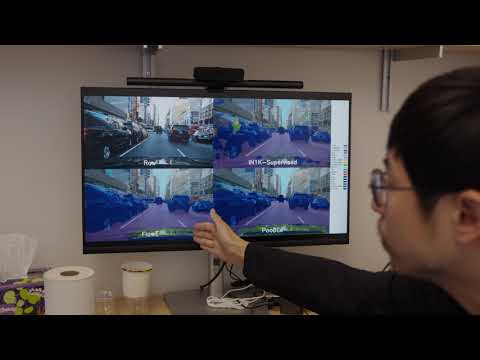
September 8, 2025
The GIST Putting AI vision into better focus with method that mimics human processing 
Gaby Clark
scientific editor

Andrew Zinin
lead editor
Editors' notes
This article has been reviewed according to Science X's editorial process and policies. Editors have highlighted the following attributes while ensuring the content's credibility:
fact-checked
trusted source
proofread

Today's AI vision is effective at recognizing simple images in isolation—such as buildings, cars, and people. But when it's called upon to identify more complex terrain, its accuracy becomes questionable. This is one of the challenges facing self-driving car technology. AI visual systems must correctly spot buildings, cars, and people—all at the same time and in a fluid environment, such as a busy intersection.
"Can we develop a learning algorithm that can directly handle data coming from what we experience—as opposed to merely recognizing simple images on a computer screen?" asks Mengye Ren, an assistant professor at NYU's Courant Institute of Mathematical Sciences and Center for Data Science.
Ren and his colleagues are building an algorithm that would do just that, enabling AI systems to learn from their environment—a street, an ocean, or even another planet—in order to effectively identify its surroundings.
Their method, PooDLe, is inspired by how humans and animals process cluttered scenes. It captures both foreground images (e.g., pedestrians crossing the street) and background images (distant cross streets) using "optical flow"—information about how pixels move between video frames. This process allows for the identification of paired regions containing the same object across time—such as a pedestrian moving from the curb to a crosswalk and continuing down a crowded street.
"PooDLe combines the best of existing AI vision tools by recognizing both big and small objects," explains Mengye Ren, an assistant professor at NYU's Courant Institute of Mathematical Sciences and Center for Data Science. "Our goal is to continue to enhance this tool so it can perceive various objects in a scene—cars, roads, traffic lights, cyclists, and so on."
Provided by New York University Citation: Putting AI vision into better focus with method that mimics human processing (2025, September 8) retrieved 8 September 2025 from https://techxplore.com/news/2025-09-ai-vision-focus-method-mimics.html This document is subject to copyright. Apart from any fair dealing for the purpose of private study or research, no part may be reproduced without the written permission. The content is provided for information purposes only.
Explore further
Attention scan: How our minds shift focus in dynamic settings 0 shares
Feedback to editors